What is the best lens for a safari?
The most useful safari lens is a telephoto zoom that reaches at least 400 mm, such as a 100–400 mm, 100–500 mm or 150–600 mm. Pair it with a standard zoom around 24–70 mm or 24–105 mm for landscapes, vehicles in the scene and animals that come close.
A long zoom earns its place because you cannot choose your distance on safari. Vehicles stay on tracks and animals move where they want, so the ability to go from a whole herd to a single face without changing position matters more than a fixed focal length. A 70–200 mm lens works well for elephants near the vehicle and for wider wildlife scenes, but it is often too short for birds, cats in long grass and anything across a river.
If you own two camera bodies, bring both, one with the telephoto and one with the wider lens. Changing lenses in a dusty, open-roofed vehicle is the fastest way to get dust on a sensor, and the best moments rarely wait. If you are flying between parks, check the weight of your kit against the luggage limit; our Kenya safari packing list covers the 15 kg soft-bag rule on light aircraft.
For travellers who want photography to be the focus of the whole trip, a private photography safari lets you set the pace: longer waits at sightings, early starts and positioning chosen for light rather than for a fixed schedule.
What camera settings should you use for wildlife?
Start in aperture priority or manual mode with auto ISO, choose a shutter speed fast enough for the subject, use continuous autofocus with a single point or animal-eye detection on the nearest eye, and shoot in RAW. Then adjust exposure compensation for bright skies or dark animals.
Shutter speed is the setting that decides most wildlife images. A resting lion tolerates a slower shutter; a cheetah sprinting or a bird taking off does not. Modern cameras handle high ISO well, so it is usually better to accept some noise than to lose sharpness. The table below gives starting points, not rules: check your histogram and adjust.
| Subject | Shutter speed | Aperture | ISO |
|---|---|---|---|
| Resting animal, portrait | 1/500 s | f/5.6–f/8 | Auto, 100–800 |
| Animal walking | 1/1000 s | f/5.6–f/8 | Auto |
| Running cats, birds in flight | 1/2000–1/3200 s | f/5.6–f/8 | Auto, accept higher values |
| Low dawn or dusk light | 1/250–1/500 s | Widest available | 1600–6400 |
| Panning for motion blur | 1/30–1/60 s | f/8–f/11 | Low |
| Landscapes from the vehicle | 1/250 s or faster | f/8–f/11 | 100–400 |
| Hot-air balloon flight | 1/1000 s | f/5.6–f/8 | Auto |
Use burst mode for action, but not for everything; thousands of near-identical frames are hard to edit. Keep exposure compensation in mind: a dark buffalo against pale grass needs less exposure, and a white egret against shade needs less again to hold detail in the feathers. Turn off any shutter sounds and focus-assist lights if your camera allows.
Beanbag or tripod in a safari vehicle?
Use a beanbag. A tripod is impractical inside a safari vehicle, where there is no room to set the legs and the vehicle itself transmits movement, while a beanbag rests on the window frame or roof edge and supports a heavy lens in seconds.
Many photographers travel with an empty beanbag and fill it on arrival with rice or dried beans, which saves weight in the luggage. A beanbag that hangs over the edge with a flat base is easier to move between window and roof. Some photographers prefer a monopod or a window clamp, but both are slower to reposition than a beanbag. Whatever support you use, ask your guide to switch off the engine for important shots, because an idling engine causes visible blur at long focal lengths.
How do you shoot from a pop-up roof Land Cruiser?
Use the pop-up roof for height and an all-round view, and shoot from the open side windows when you want a lower, more intimate angle. A low angle near eye level usually gives a cleaner background and a stronger image than shooting down on an animal.
Safari World Africa uses modified 4x4 Land Cruisers with pop-up roofs, which give each guest room to stand and turn. Standing is ideal for scanning and for wider scenes; sitting at the window brings you closer to the animal's eye line. Agree a routine with others in the vehicle so nobody moves while someone is shooting at a slow shutter speed, since one person shifting their weight can shake every lens on board.
Talk to your guide about light and background. A good guide will think about where the sun is and where an animal is likely to walk, and will position the vehicle accordingly, within the park rules. On a private safari you can also agree to wait longer at a promising sighting rather than moving on.

When is golden hour on a Kenya safari?
Close to the equator, sunrise and sunset barely change through the year. In Nairobi during 2026, sunrise falls between about 06:12 and 06:43 and sunset between about 18:22 and 18:53, so golden hour is roughly the first hour after dawn and the last hour before dusk, every month.
The earliest sunrises and sunsets come in late October and early November, and the latest in February. Parks to the west of Nairobi, including the Masai Mara, see sunrise and sunset a few minutes later. Because the sun rises and sets steeply near the equator, twilight is short and the warm light changes quickly, so plan to be out at the start of the morning drive rather than arriving at a sighting once the light has gone flat.
The middle of the day is harsh for photography, with hard shadows and heat shimmer at long focal lengths. Use it to back up cards, charge batteries and review images, or look for subjects in shade.
How do you photograph a balloon safari?
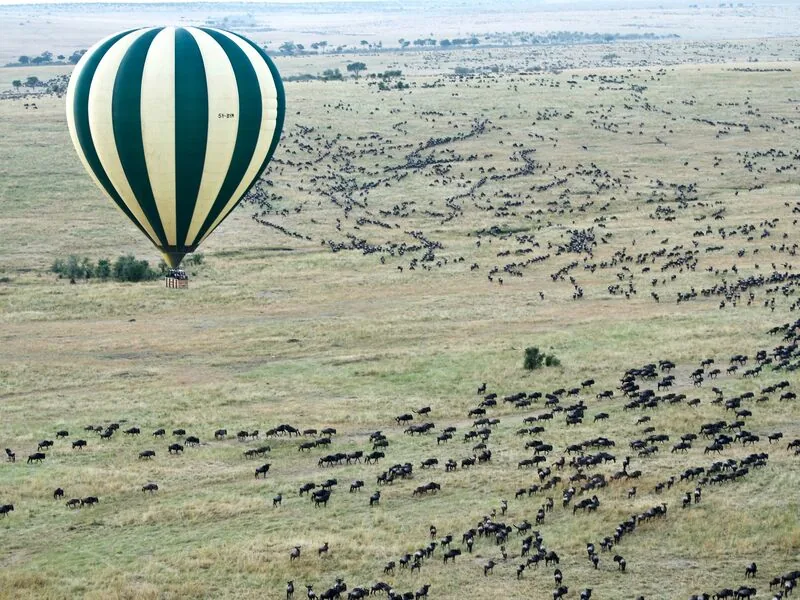
Bring one camera with a mid-range or wide zoom, set a fast shutter speed of around 1/1000 s, and keep the strap around your neck. Balloon flights in the Masai Mara begin just before dawn, so expect low light at take-off and better light as the sun clears the horizon.
There is no room in the basket for a tripod or for changing lenses, and anything you drop will not come back. A 24–105 mm or 70–200 mm lens covers both landscapes and herds below, and a wide lens captures other balloons in the sky. Shoot a mix: animals from above, the shadow of the balloon on the grass, and the landscape opening up as you climb. A balloon flight is offered as an option on our Masai Mara safari.
Can you take good safari photos with a phone?
Yes, for landscapes, close animals and scenes that include the vehicle or camp, but phones struggle with distant wildlife. Use the phone's built-in telephoto lens rather than heavy digital zoom, hold it steady against the vehicle and use burst mode for movement.
Wipe the lens often, since dust softens phone images quickly. Tap to set focus and exposure on the animal, then lower the exposure slightly for bright skies. Some travellers hold a phone to one eyepiece of their binoculars to reach further; it takes practice but can work for record shots. Above all, do not let the screen replace the experience: a phone is ideal for quick shots, then you can put it down and watch.
What are the ethics and rules of safari photography?
Never ask your guide to drive off-road, get too close or disturb an animal for a photograph. Off-road driving and harassing animals are against the rules in Kenya's national parks and in the Masai Mara, where Narok County announced in 2024 that drivers and guides who break them risk on-the-spot fines and a ban on their vehicles entering the reserve.
Kenya Wildlife Service rules for Nairobi National Park state that off-road driving is strictly prohibited and that visitors must remain in their vehicles except in designated areas. In the Mara Triangle, the published park rules require waiting vehicles to keep 100 metres away and limit viewing to 10 minutes when more than five vehicles are waiting at a sighting.
Good practice goes beyond the rules: keep voices low, never call or make noises to make an animal look up, and give space to animals that are hunting, feeding or with young. A patient guide who keeps a respectful distance usually gets better behaviour, and better photographs, than one who pushes in. Our approach to wildlife is outlined on our conservation page.
Can you fly a drone on safari in Kenya?
Not without advance permits. Kenya's drone regulations require a Kenya Civil Aviation Authority (KCAA) permit to import a drone, registration with KCAA and KCAA authorisation to fly it, and import permits need security clearance first.
Parks and reserves may impose their own restrictions in addition to KCAA rules, so a KCAA approval alone should not be assumed to cover flying over wildlife. For a holiday safari, the practical advice is to leave the drone at home. Questions about specific photography plans can go through our enquiry form.