When is the Great Migration?
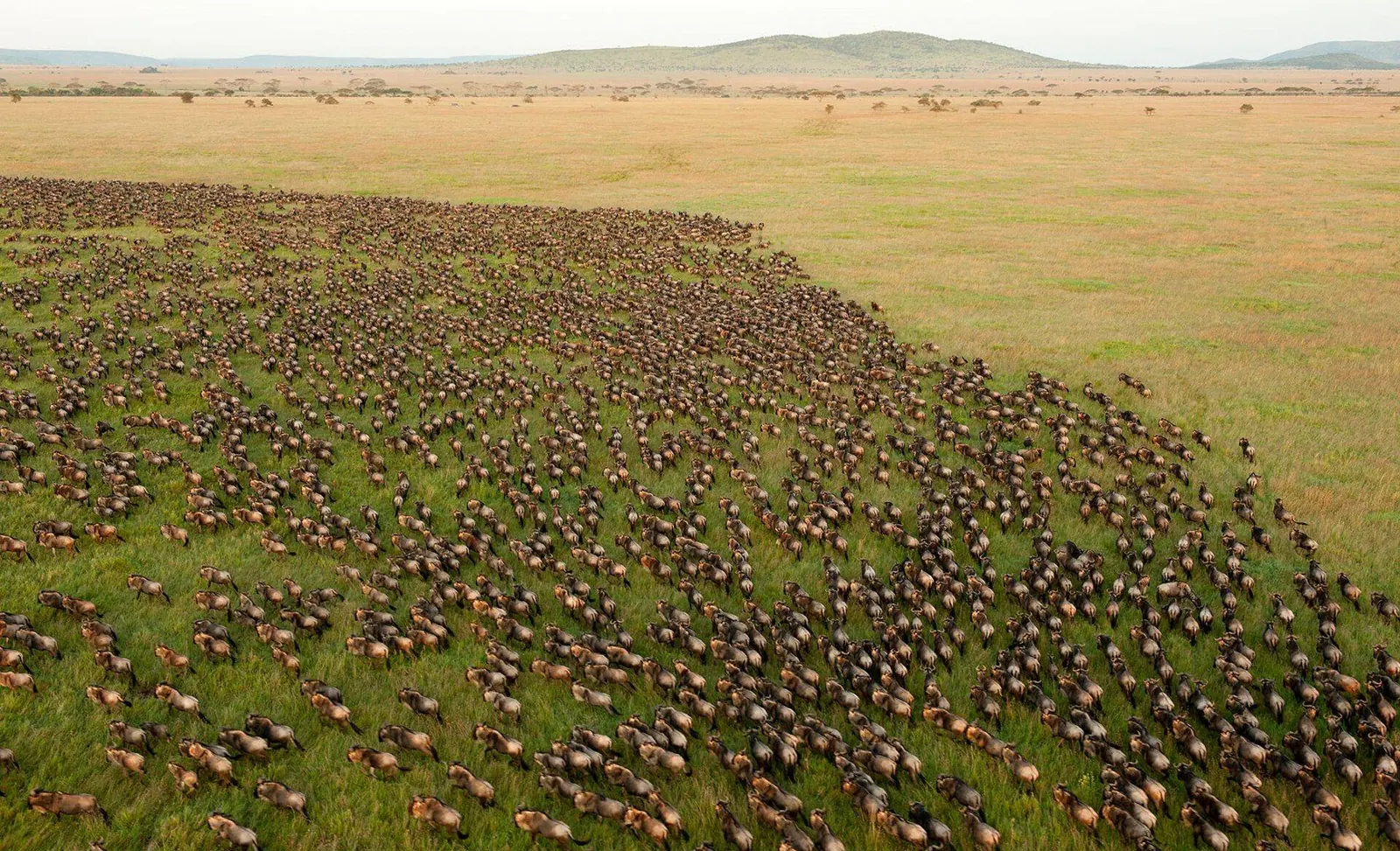
The Great Migration is not a single event but a year-round, roughly circular movement of wildebeest, zebra and gazelle through the Serengeti–Mara ecosystem of Tanzania and Kenya. In a typical year the herds calve in the southern Serengeti from about January to March, move north and west through the Serengeti from April to June, and reach the Mara River and Kenya's Masai Mara from around July to October before heading south again.
UNESCO describes the circuit as an annual trek of about 1,000 kilometres spanning the two countries, and calls it the largest remaining unaltered animal migration in the world. The animals follow the rains and fresh grazing, so the herds are always somewhere in the ecosystem; the question is where, and what they are doing at the time you visit.
How many animals take part?
Estimates vary by source and by year. Tanzania National Parks (TANAPA) cites over 1.5 million wildebeest, zebra and predators involved in the migration, while UNESCO's World Heritage listing for Serengeti National Park describes the ecosystem as supporting around 2 million wildebeest, 900,000 Thomson's gazelle and 300,000 zebra as the dominant herds. A fair summary is that well over a million wildebeest move through the system each year, accompanied by hundreds of thousands of zebra and gazelle.
Where are the herds each month?
The table below shows where the herds usually are in an average year. Treat it as a guide to probabilities, not a timetable: rainfall decides the timing, and the herds can split, stall, double back or arrive weeks early or late.
| Month | Where the herds usually are | What you might see |
|---|---|---|
| January | Southern Serengeti and the Ndutu area of the Ngorongoro Conservation Area | Large herds on the short-grass plains; calving begins |
| February | Southern Serengeti and Ndutu | Peak calving, usually around mid-February; predators follow the herds |
| March | Southern plains, starting to drift north and west | Young calves with the herds; long columns begin to form |
| April | Southern and central Serengeti, often dispersed | Long rains; herds on the move, lush green landscapes |
| May | Central Serengeti towards the Western Corridor | Herds moving west and north; some near the Grumeti River |
| June | Western Corridor and moving north | Grumeti River crossings in some years; herds heading towards Kenya |
| July | Northern Serengeti (Kogatende, Lamai) and the southern Masai Mara | First Mara River crossings, timing varies widely year to year |
| August | Northern Serengeti and the Masai Mara | Frequent Mara River crossings in both directions |
| September | Masai Mara and northern Serengeti | Crossings continue; herds spread across the grasslands |
| October | Masai Mara and northern Serengeti | Herds begin moving south as the dry season ends, typically late in the month |
| November | Moving south through the Serengeti | Short rains; herds travel fast and can be hard to pin down |
| December | Arriving back in the southern Serengeti and Ndutu | Herds settling on fresh grazing ahead of calving |
The pattern above draws on TANAPA, Lonely Planet and long-running safari operator reporting. All of them stress the same point: the migration is driven by rainfall, and no one can promise where the herds will be on a given date.
What is the best month to see the Mara River crossings?
August is usually the most reliable month for Mara River crossings, with July and September close behind and crossings possible into October. Lonely Planet notes that the herds most often reach the Mara River by early to mid-July, but that in some years this happens in June, in others August, and occasionally the expected crossing never materialises.
Crossings are unpredictable even when the herds are on the riverbank. Animals may gather for hours or days before a crossing starts, then turn back. Some crossings involve a few dozen animals, others many thousands. Because of this, it is wise to spend at least three or four nights in a crossing area rather than one or two, so you have several chances.
TANAPA describes the Mara River as the only water source in the Serengeti that can sustain the migration through the dry season, which is why it becomes so important at that time of year. TANAPA has published guidelines for its side of the river: vehicles park at designated crossing points, stay stationary, remain on one side of the river and must leave animals enough space to pass. Expect similar etiquette on the Kenyan side, where good guides position the vehicle well back so the herd is not pushed away from the water.

When is calving season, and where is it?
Calving takes place on the short-grass plains of the southern Serengeti and the Ndutu area of the Ngorongoro Conservation Area, usually between January and March. TANAPA records that more than 250,000 wildebeest calves are born each year, with about four-fifths born within a short window of a few weeks, typically peaking around mid-February.
This synchronised birthing is a survival strategy: so many calves arrive at once that predators cannot take them all. For visitors, it means dense herds, newborn calves standing within minutes, and predators drawn to the herds in large numbers. It is also a good time to combine the migration with the Ngorongoro Crater, which lies close by. Our Great Migration and Serengeti safari pairs the Serengeti with Tarangire and Ngorongoro, and the timing can be set around calving.
Serengeti or Masai Mara for the migration?
Choose the Serengeti if you want the greatest choice of months and the calving season; choose the Masai Mara if you want the best concentrated chance of river crossings and big herds between about July and October. The herds spend most of the year in Tanzania, and in most years only part of the year in Kenya.
Scale is the main difference. The Serengeti National Park covers roughly 14,763 square kilometres, while the Maasai Mara National Reserve, established in 1961, covers about 1,510 square kilometres. The Mara is smaller and the herds are more compressed when they arrive, which makes for dense game viewing in a short drive. The Mara Triangle section of the reserve is managed by the Mara Conservancy on behalf of the county government.
The trade-off is crowding. Lonely Planet identifies July and August as the busiest months in the Mara, and popular crossing points on both sides of the border can draw many vehicles. In Kenya, the private conservancies bordering the reserve limit vehicle numbers and allow activities such as guided walks and night drives, which helps when the reserve is busy. Our guide to choosing between Kenya and Tanzania covers these differences in more detail.
If the Mara is your focus, our classic Masai Mara safari includes time in the Mara Triangle and the option of a hot-air balloon flight over the plains. Co-founder Nigel Archer owns Naibor Camp in the Maasai Mara, so the team knows the area well.
Can you see both in one trip?
Yes. Combining Kenya and Tanzania lets you follow the herds rather than gamble on one location, and suits travellers who want both the Mara and the wider northern Tanzania circuit. A common approach is to visit the Masai Mara during peak crossing season and add the Serengeti, Ngorongoro or a beach stay in Zanzibar afterwards. Crossing between the two countries brings its own entry and health paperwork, which is covered in our Kenya or Tanzania guide.
Why are migration timings never guaranteed?
Because the herds follow the rain, not the calendar. When the rains arrive early, late, heavily or patchily, the grazing changes and the animals respond. Lonely Planet notes that herds may split, double back or skip sections entirely, especially after unseasonal rain.
Three practical steps reduce the risk. First, choose months when the probabilities are highest for what you most want to see: February for calving, August for crossings. Second, allow enough nights in one area to wait for the action. Third, travel with a guide who has up-to-date information from the field and can move with the herds. Our private safaris use modified 4x4 Land Cruisers with pop-up roofs, and because you are never grouped with strangers, your guide can change plans around the herds rather than a fixed group schedule.
It also helps to remember that the Serengeti and Masai Mara both have resident wildlife all year. Many animals stay put while the herds move on, so a safari outside the peak months still offers strong game viewing, and is often quieter. For more on timing, read our guide to planning your first safari, and see our photography safaris if the crossings are your main goal.