← Back to Blog
What is the Great Migration?
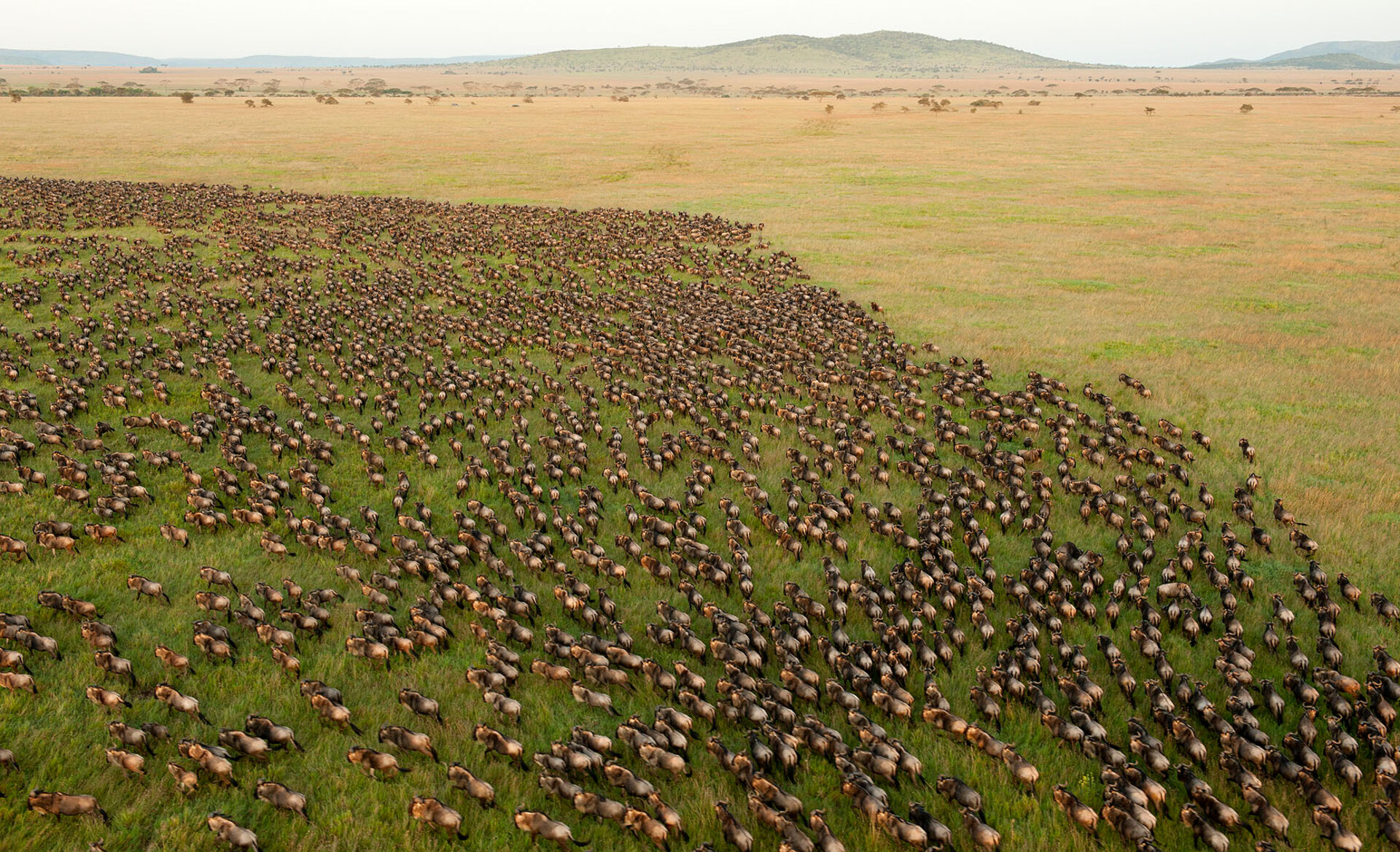
The Great Migration is the annual movement of roughly 1.5 million wildebeest, 200,000 zebras and hundreds of thousands of gazelles around the Serengeti-Mara ecosystem of Tanzania and Kenya. It is, by most measures, the largest overland migration of mammals on Earth and one of the seven natural wonders of Africa.
What many first-time visitors don't realise is that the Migration is not a single event. It's a constant, year-round circular movement driven by rainfall, fresh grazing and the instinct to reach the best calving grounds at the right moment. At no point do all the animals gather in a single place — they're strung out across the ecosystem at any given time, with the herds concentrating in different regions depending on the month.
That's why timing your visit matters so much. Book the wrong week and you'll see beautiful scenery but find the migration several hundred kilometres away. Book the right one, and you'll witness one of the most extraordinary natural events on the planet.
January to March: Calving season in the southern Serengeti
By January the herds have moved south onto the short-grass plains of the southern Serengeti and Ndutu Conservation Area. This is where calving happens. In a roughly three-week window from late January into February, around 400,000 wildebeest calves are born — some 8,000 every single day. The predators know this. Lion prides, leopards, cheetahs and spotted hyenas converge on the area, and the game viewing is extraordinary.
This is our pick for wildlife drama on a budget. Lodges in the southern Serengeti and Ndutu tend to be less expensive than northern-Serengeti migration camps, and crowds are lighter than in peak migration season. The photography is exceptional — short grass, open plains, dramatic predator-prey interactions, and newborns everywhere you look.
Who it suits: photographers, return visitors, anyone wanting predator action over dramatic river scenes, families with older children.
April and May: The long rains and the green season
April and May bring the long rains. The herds begin moving slowly northwest, following fresh grass through the central Serengeti. Roads can become muddy, some airstrips close for maintenance, and lodge rates drop significantly.
This is not a bad time to go — quite the opposite, if you're prepared. The landscape is gloriously green, skies are dramatic for photography, crowds are almost non-existent, and wildlife remains plentiful. It's the best-value window of the year. Our advice is to stay in the central Serengeti at properties with all-weather road access.
Who it suits: photographers, budget-conscious travellers, return visitors who've already done peak season, people who hate crowds.
June and July: Building toward the crossings
By June the herds have reached the western Serengeti and begun the slow push north. This is the start of the 'dry season' and game viewing sharpens dramatically as water sources shrink and animals concentrate around the remaining rivers. Lodge rates climb and availability tightens.
By late June or early July the first herds reach the Grumeti River in the western corridor, where they face the first major crossings and the infamous Grumeti crocodiles. It's a quieter, less-photographed part of the migration than the Mara River crossings that follow, but the drama is every bit as real.
Who it suits: visitors who want the dry season experience without peak-season prices and crowds of mid-August.
August to October: Mara River crossings — peak season
This is what most people picture when they think of the Great Migration. From roughly mid-July through late October the herds are in the northern Serengeti and Masai Mara, facing repeated crossings of the Mara River. The crossings are the single most iconic wildlife event on Earth — thousands of animals plunging down steep banks into crocodile-infested water, with a predator-heavy audience on both sides.
Crossings are unpredictable. Herds can gather on the riverbank for hours or days before one animal finally commits and triggers a stampede. Experienced guides know the favoured crossing points and read the behaviour — position well and you may witness multiple crossings in a single day. Others wait and see nothing. This is where a knowledgeable guide and a flexible itinerary pay off.
Peak season means peak prices and peak camps fill 9-12 months ahead. If a northern-Serengeti migration camp or a Masai Mara private conservancy is on your wish list for August or September, you need to book early. We recommend at least nine months, and ideally a full year, of lead time.
Who it suits: first-time safari goers who want the classic Migration experience, photographers hunting the iconic river-crossing shot, travellers who can book well in advance.
November and December: The short rains and the return south
The short rains in November begin to green up the southern Serengeti again and the herds start the long journey back south. By December most are in the central and southern Serengeti, preparing for the calving cycle to begin again. Game viewing is excellent, crowds thin out after early November, and rates soften.
December 20 onwards is the Christmas and New Year peak — lodges raise rates and fill fast. If that's your window, book early. Otherwise, early-to-mid November and early December are hidden gems.
Serengeti or Masai Mara: which side should you pick?
The Mara River is the border between Kenya (Masai Mara) and Tanzania (northern Serengeti), and the Migration crosses it repeatedly in both directions during August-October. Both sides have their advantages.
The Masai Mara is more compact and the reserve has a higher density of big cats than almost anywhere else on Earth. You see more in less time. Private conservancies on the Mara's borders (Mara North, Olare Motorogi, Naboisho) offer exclusive access, walking safaris and night drives. The downside: the main reserve can be busy during crossings, with vehicles clustered at active crossing points.
The northern Serengeti is vastly larger and generally has fewer vehicles per sighting. The landscape is more varied, with koppies, rocky outcrops and long vistas. Migration camps in the northern Serengeti tend to be more expensive but deliver a more exclusive-feeling experience during peak season.
Our usual recommendation is to combine them: two or three nights in each, with a light-aircraft transfer over the border. You get the best of both ecosystems and massively increase your chances of witnessing a classic crossing.
How many days do you need?
For a Migration-focused safari we recommend a minimum of five nights on the ground — three nights in a northern-Serengeti or Mara migration camp, with two additional nights elsewhere in the ecosystem. That gives you enough game drives across different areas to raise your odds of seeing a major crossing.
Seven to ten nights is the sweet spot for serious wildlife enthusiasts and photographers. It lets you split time between the southern/central and northern Serengeti, or combine northern Serengeti with the Masai Mara, or add on a visit to Ngorongoro Crater.
Fourteen nights gets you everything — southern plains, northern crossings, Ngorongoro, a private conservancy, and enough flexibility to spend a whole day parked at a crossing point if that's what the animals demand.
Booking: what to watch out for
The two mistakes we see most often from migration-season travellers are (1) booking a camp in the wrong part of the Serengeti for their chosen month, and (2) booking too late to get into the best camps at all.
The migration moves on a rough calendar but actual animal movements can vary by two or three weeks in either direction depending on rainfall. A good tailor-made operator will watch the herds in the months before your trip and — if bookings allow — shift you between camps to put you in the right place.
Our strong recommendation: work with a Nairobi-based operator (or one who actually works with Nairobi-based ground handlers) rather than a purely UK or US-based travel agent. The difference in real-time information and flexibility is enormous.
Final word
The Great Migration is, without hyperbole, one of the most extraordinary wildlife experiences available anywhere on Earth. Get the timing and the camp choice right and it will stay with you for the rest of your life. Get it wrong and you'll still have a wonderful safari — the Serengeti is outstanding year-round — but you'll wish you'd planned better.
If you're thinking about a Migration safari, get in touch. We're based in Nairobi, we know the ground, and we can build the trip around the phase of the migration that matches what you most want to see.